
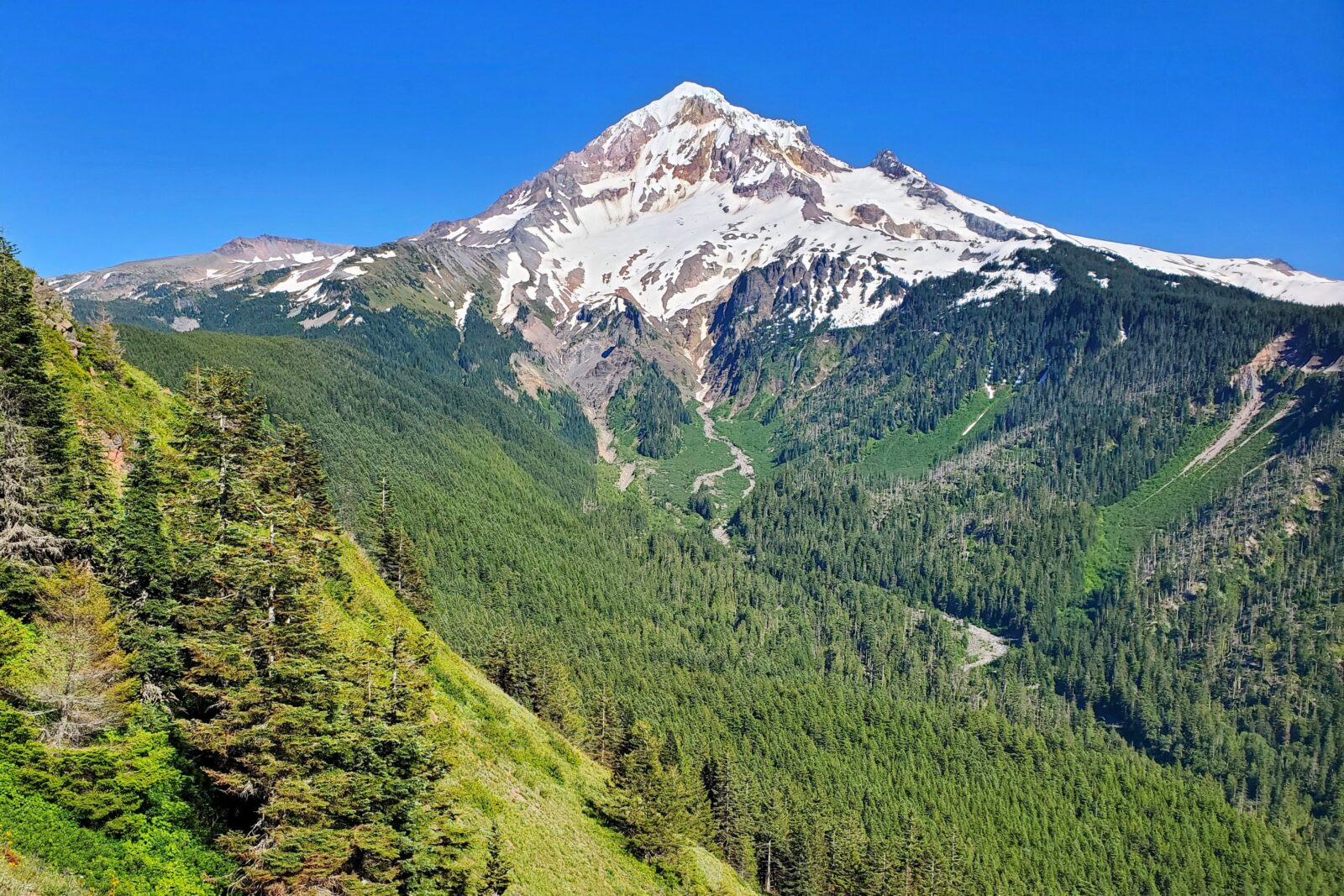
Please help stop a bill that puts Mt. Hood’s forests, rivers, fish, and wildlife at risk.
Passed by the U.S. House of Representatives with little fanfare on Dec. 9th last year, Representative Cliff Bentz’s HR 655 is a dangerous bill that would transfer 150 acres of federal public land from the Mt. Hood National Forest — including water from the Dog River that flows off Mt. Hood into the Hood River — to the City of The Dalles in the nearby Columbia River Gorge, home to a six-building Google data center campus with skyrocketing water and energy needs.
HR 655 would put the forests, rivers, fish, and wildlife of the Mt. Hood National Forest at risk if it were to become law, and set a dreadful precedent for the use of our federal public lands. But when Congressman Bentz (OR-2) secured passage of HR 655 in the House, his office bragged about it in a press release.
A longtime Republican politician now in his third term in the U.S. House, Bentz’s congressional district includes the entirety of Eastern Oregon, then makes a left hook into the southwestern corner of the state to include Klamath Falls and the cities of Ashland, Medford, and Grants Pass in the Rogue Valley.
“Hubristic Imposition” of Speculators on Public Lands
One of the bigger concerns we conservationists have with HR 655 is its hubristic imposition on the idea of federal public lands, and using those public lands as a placeholder — as though the land is just waiting in a bank until it can be plucked away for what Google, or other corporations or oligarchs, might consider to be its “highest use.” In their case, they would see that “highest use” as serving them, rather than the public which owns the land, or the idea of the land being part of a larger natural space or ecosystem, as the Mt. Hood National Forest has been since it was established in 1908 to stop runaway land and timber speculation by logging barons, and managed, as the Forest Service still likes to say, for “multiple use” for the public benefit.
Sure, I have my concerns with the unusually elastic definition of what “multiple use” may mean from one decade to the next, but I understand the idea of multiple use, and I can adhere to it insofar as the public has a built-in say as to how our public lands are being managed and used. That’s part of the American social contract, and one of the many good reasons National Forests were established: to prevent oligarchs and the wealthy from having a one-sided, universal say in how our lands are used. If we believe our nation’s agencies or governing bodies — in this case, the executive branch or the president who oversees the Department of Agriculture that’s the parent agency of the Forest Service — is doing a poor job managing our public lands we can, ideally, vote them out.
We can also pressure our congressional members to hold investigations and pressure the administration to remove, demote, or fire individuals charged with responsibility who may be doing a poor, or reckless, or even destructive job. And through policies like NEPA, i.e. the National Environmental Policy Act, we have a say as to what’s occurring on public lands during comment periods for project proposals. And the environment and best conservation practices get a seat at the table with the public. Unfortunately, during the Trump administrations, and with the help of more than a few Vichy Democrats, we’ve seen NEPA attacked and reduced by pro-development interests, and comment periods during this second Trump administration gutted to insultingly brief periods of time, sometimes as little as a week.
So, bureaucratically, how we respond to changes to our federal public lands is more and more being reduced to keep the public at bay. That’s no accident.
Early Media and Conservation Response
WaterWatch of Oregon, along with a coalition of angling, land-use, and conservation organizations including Bark, Columbia Riverkeeper, Association of Northwest Steelheaders, Native Fish Society, Bird Alliance of Oregon, and other organizations sent a letter of concern about HR 655 to Senators Ron Wyden and Jeff Merkley in February. Since then the coalition has had their respective members make their opposition to the bill known, and both senators appear to have received the message. Wyden acknowledged he would oppose HR 655 in August, albeit via a social media posthis staff posted a day before an anti-HR 655 rally at his Portland office that myself and others spoke at.

Along with the help of some early reporting by Oregon Public Broadcasting and an article in SFGate, the public began to learn more about the unprecedented public land “transfer” facilitated by HR 655, along with the impact the transfer would have on the Hood and Dog rivers, the five runs of endangered salmon and steelhead that would be affected, the bill’s willful erosion of public oversight, the terrible precedent it would set for our federal public lands in an era in which the Trump regime is dismantling America’s public lands legacy as fast as it can be arranged, and how HR 655 would enable The Dalles — and thereby, Google — to sidestep federal reviews of their growing water infrastructure. To no one’s surprise, this has proved to be wildly unpopular with Oregonians.
Interestingly, the increase in awareness over HR 655 coincided with the growing opposition among Americans to out-of-control tech giants like Google building data centers throughout the country, depleting water supplies and aquifers along the way, and frequently earning over-the-top tax breaks from communities enchanted by vague promises of wealth and employment. Today, Congressman Bentz is no longer bragging about HR 655. In fact, he’s become downright shy about his authorship and advocacy for it — and his damning complicity in its creation.
Why the shyness? Because from the Meta (Facebook) data center complex in Prineville, to the nitrate-polluting Amazon data center complex in Boardman, to the Intel and X (Twitter) data center complexes in Hillsboro, Oregon is now the leading location of data centers in the United States, second only in the world to the Beijing metropolitan area. Oregonians aren’t happy with any of this, and especially loathe the idea of “transferring” federal public lands of their beloved Mt. Hood National Forest to ensure a data center complex — owned by the biggest corporation in the world — doesn’t have to follow the rules everyone else does, or work with federal agencies, or deal with cranky public processes in acquiring water. And only in The Dalles is an outright land grab of our public lands not only being facilitated by a willing local politician, but is now only two votes away from the desk of a demented, corrupt president known for his indulgence in lunatic AI slop that eats up enormous amounts of data center bandwidth to produce.
Impact on Native Fish and River Temperatures
HR 655 would harm five Endangered Species Act-listed runs of salmon and steelhead in the Hood River and Dog River. The Dog is an important tributary of the Hood, and some of that watershed was recently impacted by the Grasshopper Fire over the summer. The Hood River flows into the Columbia, and because of the Hood’s importance and cold water volume, HR 655’s impact would, in fact, extend to all aquatic species migrating in the Columbia River where there is a larger concern about cold water flows no longer being particularly cold — and the death and impairment to native fish species as a result of that warming water environment.
As my former WaterWatch colleague John DeVoe noted in WaterWatch’s coalition letter to Senators Wyden and Merkley, the EPA identified the Hood River as an “excellent” cold-water refuge for salmon migrating in the Columbia River that rely on its significantly cooler waters when temperatures in the Columbia are too warm and unsafe for salmon. Despite the EPA having identified the Hood as a “primary” cold-water refuge for migrating salmon, the lower Hood River already violates Oregon water quality standards for temperature. For this reason, the EPA identified the need to “maintain and increase flows in the Hood River Basin,” and noted that at the Hood’s confluence with the Columbia River, Hood River flows are already overallocated from 144 to 216 percent from June through September. And that’s without HR 655 even in the picture.
Removing cold water from the Dog River to benefit Google’s six-building data center complex downstream will further reduce Hood River flows, cause increased water temperatures downstream, and undercut the Hood River’s cold-water refuge capability, as well as the Oregon Department of Environmental Quality’s attempts to cool temperatures in the Hood.
If the City of The Dalles fully uses the water diversion capacity HR 655 is designed to facilitate with the use of 150 acres’ worth of water running out of the Mt. Hood National Forest, it could completely de-water the Dog River during the dry summer months, except for what can only be described as a minimal, trickle of a bypass flow at the pipeline intake of The Dalles reservoir at the center of this legislation to enable the theft of federal public land.
From the House to the Senate
After its passage in the House at the end of 2025, HR 655 moved to the U.S. Senate and the powerful Senate Energy and Natural Resources Committee, chaired by notorious public lands enemy and extraction industry lackey Mike Lee of Utah, last seen cackling like a schoolboy as Trump signed executive orders dismantling Bears Ears and Grand Staircase Escalante National Monuments in July. For months, opponents of HR 655 waited for the bill to be heard before the committee in order to submit comments. While we were disappointed to learn HR 655 was granted something of a clandestine hearing in July in the Senate Subcommittee on Public Lands, Forests, and Mining, which falls under the Senate Energy and Natural Resources Committee’s purview, it provided the cue for the public to begin weighing in with opposition to HR 655.
Here’s where we could use your help. Using the letter below as a “copy and paste” template, submit your testimony opposing HR 655 to the Senate Energy and Natural Resources Committee. The email address to send it to is fortherecord@energy.senate.gov.
Be sure to include your name and address, and note that your testimony is in response to HR 655 and the July 15th subcommittee meeting on the bill. Please urge the committee to oppose HR 655 and its reckless impacts on fish, cold water flows, public land, and public oversight.
Dear Chairman Barrasso, Ranking Member Cortez Masto, and Members of the U.S Senate Subcommittee on Public Lands, Forests, and Mining,
I wholly oppose HR 655. The proposed transfer of 150 acres of federal public land from the Mt. Hood National Forest to the City of The Dalles is terrible policy that sets a terrible precedent for our threatened federal public lands.
The bill is an end-run around public engagement and oversight, and an attack on water, forests, public lands, and the protection of endangered species that puts the interests of a wealthy corporation and their political allies ahead of the interests of everyday Oregonians.
The rules that safeguard Oregon’s salmon, water, and outdoors are not simply “red tape” to be eliminated in the name of expediency. They exist for a reason. Circumventing them in HR 655 is unacceptable.
We urge you to stand with Oregonians and the rules that protect fish, water, conservation values, and the ability for the public to participate in decisions affecting public lands. These rules are vital to preserving the natural treasures that make Oregon a special place to live, work, and raise a family.
Please reject passage and vote no on HR 655.
Thank you for your consideration.
Sincerely,
[ your name ]
[ your mailing address ]
As noted, in the immediate path of HR 655 is a junior instream water right on the Dog River that supports multiple runs of Endangered Species Act (ESA) listed fish between it and the Hood River that will be significantly affected. It is intolerable that HR 655 would simply jettison long-standing, reasonable, and measured restrictions, designed to help ensure the survival of native fish listed under the ESA, all in the name of “cutting red tape.” No way. Not in Oregon. Not anywhere.
Is Your Local Politician Quietly Backing Data Centers?
From water bills to nitrate contamination to the survival of the state’s iconic runs of native fish, submitting comments also give Senator Wyden, who serves on the Senate Energy and Natural Resources Committee, ammunition he can use in D.C. and share with his fellow committee members to illustrate how Oregonians are fed up with data center expansion and oppose HR 655 and its destructive, reckless impacts on water, endangered fish, cold water flows, public land, and public oversight.
One wonders if Representative Bentz’s constituents will ever put two and two together and realize their congressman is not only behind HR 655, but actively working in the service of acquiring already over-allocated water to enable data center operations. While Oregon’s Democratic Governor Tina Kotek is facing strong headwinds this year against her MAGA Republican challenger, in part due to Kotek’s technocratic, less-than-personable approach, her tacit support of the data centers that have appeared around the state since her election in 2022 (granted, this is part of a longer trend in Oregon dating back 20 years), and her reluctant leadership and unwillingness to consider a more overarching, broad moratorium on data center expansion, Bentz may yet survive this year’s midterms despite his authorship of HR 655. Kotek may not be so lucky.
Please share this with your family and friends and take action to advocate for Mt. Hood. A committee vote on HR 655 is expected soon. Weigh in with testimony to stop this vulgar public lands “land grab” that puts the rivers, fish, forests, and wildlife of the Mt. Hood National Forest at risk.
Banner photo of the Mt. Hood Wilderness and triptych photo of Cold Spring Creek (East Fork Hood River tributary) by Tommy Hough; photo of Tommy speaking at Oregon Wild’s Aug. 23rd Rabble Rouser event in Portland by kind courtesy of photographer Andy Neal.
