
By Suzanne Cable
As anti-conservation forces increasingly use deceptive terms like “tending” as a means of sidestepping the doctrines of the landmark 1964 Wilderness Act to facilitate the use of machines and greater human impact in Wilderness areas, this piece by Suzanne Cable, who served 30 years with the U.S. Forest Service, posits the best approach to stewarding federally-designated Wilderness is to simply adhere to the text and intent of the Act passed by Congress.
Contradictory to what is advocated for in recent article by U.S. Forest Service research fellow Clare E. Boerigter about protecting Wilderness by purposefully “tending it,” the best approach to the overall stewardship of federally designated Wilderness is to do as the 1964 Wilderness Act dictates: leave it alone.
As a retired Wilderness manager with the Forest Service, reading this article really hit a nerve with me. This approach of advocating for management of Wilderness is contradictory to the intent and letter of the law and disturbing. Attempting to stop the ecological clock by human manipulation of Wilderness areas to achieve human-determined preferred conditions through “tending” is detrimental to the continued responsible stewardship of federally designated Wilderness as intended by the Act.
Effective wilderness stewardship takes the long view, and “leaving it alone” — such as limiting direct human control and deliberate manipulation of the ecology of Wilderness — is foundational to the long-term preservation of Wilderness. Quoting directly from the text of the Wilderness Act, “A wilderness, in contrast with those areas where man and his works dominate the landscape, is hereby recognized as an area where the earth and its community of life are untrammeled by man.” Key concepts of this statement are “in contrast” and “untrammeled by man.” Wilderness must be allowed to be in contrast with other areas of earth that are dominated by humans and free from direct human ecological intervention.
Manipulation of wilderness to achieve a condition based on a point in the long arc of ecological time to achieve human interests is the antithesis of humility and restraint, hallmarks of wilderness stewardship.
The less than three percent of land in the contiguous United States designated as Wilderness, or about five percent of all lands including Alaska, is worth protecting from the manipulative arrogance of humans to control natural conditions for the “benefit” of those systems as well as humans. That five percent deserves to be left alone, allowing nature to rule, and to be protected from perhaps well-intentioned, but ultimately regretful ecological interventionist actions. Is five percent of the over two billion-acre U.S. land base too much to leave uncontrolled by humans since humans have decided to have their way with the other 95 percent? I say no, and in fact, I’d argue five percent is not nearly enough.
The article uses the example of manager-ignited fire as necessary tending. Manager-ignited fire damages the very qualities that define Wilderness character in all wildernesses: untrammeled, natural, undeveloped, and offering outstanding opportunities for solitude or primitive and unconfined recreation. And once started to achieve specific desirable conditions, manager-ignited fire and other interventions must continue in perpetuity to hold back the trajectory of change to achieve the historical condition of one point in time. Thereafter, what about the place remains wilderness and in contrast to other National Forest lands? It fundamentally changes the place, loses the qualities that define why it is protected as Wilderness, and becomes another landscape controlled and manipulated by humans.
Rather than promoting wilderness “tending,” it would be great to see the Forest Service conduct research that provides land managers and the public with useful information consistent with the Wilderness Act versus proposing strategies that would lead managers to take actions that are destructive to the intent of the Act. For example, providing decision support tools to managers about how to allow more naturally ignited fire to burn in Wilderness, rather than being suppressed, would really help.
The article feeds the metaphorical fire of human action bias — to try to fix things that aren’t meeting their desired conditions. Wilderness is one land designation where the action bias is both prohibited by law and also contradictory to achieving its preservation objectives.
Suzanne Cable wrapped up her 30-year career with the U.S. Forest Service as the forest-wide program manager for recreation, trails, and Wilderness for the Okanogan-Wenatchee National Forest in Washington. She now serves as a board member with the Montana-based conservation nonprofit Wilderness Watch. This widely distributed piece originally appeared in several newspapers and websites the week of April 10, 2026.
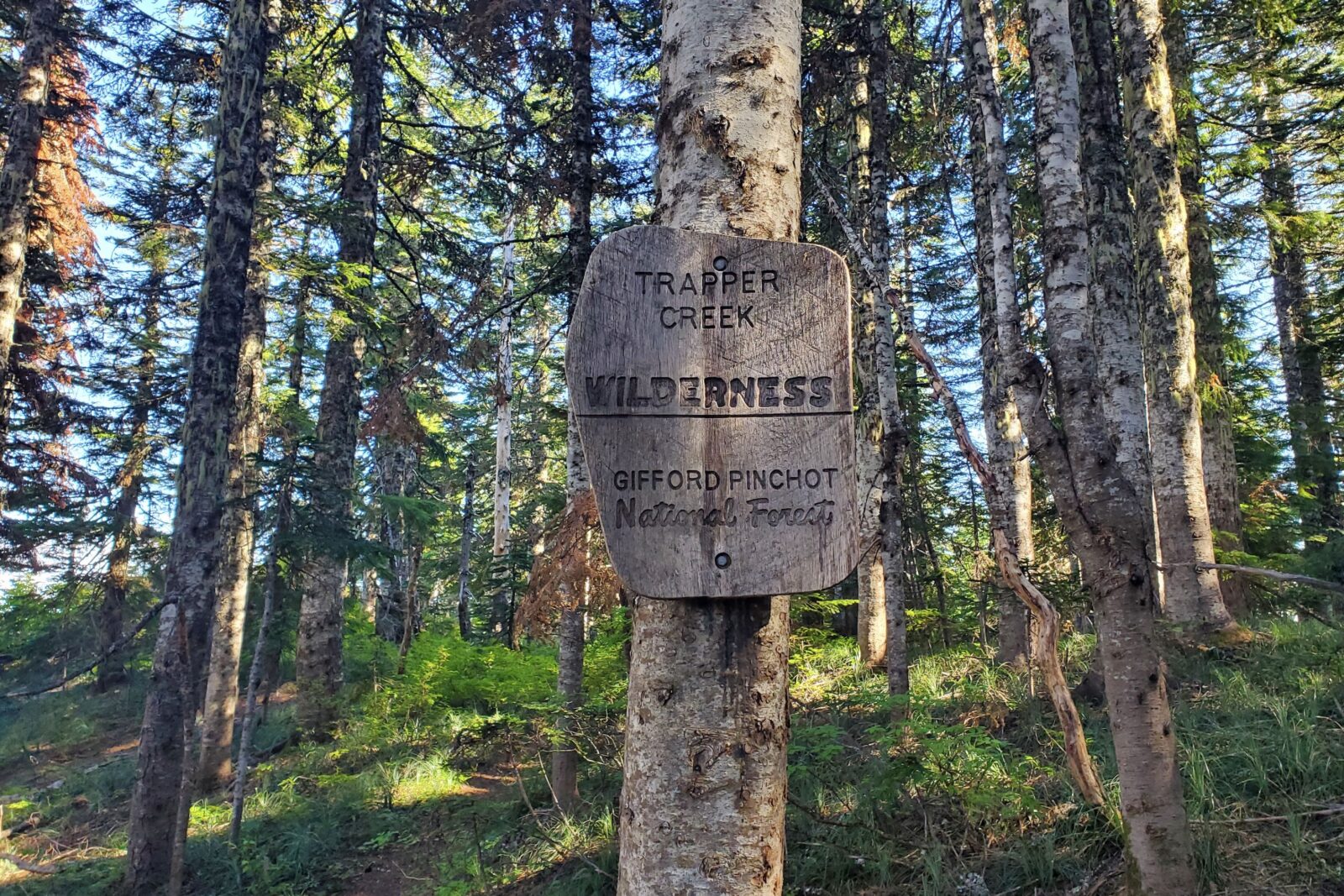
Trapper Creek Wilderness photo © 2023 Tommy Hough, all rights reserved.